Table of Contents
Summary
AddressSanitizer: a fast address sanity checker is a paper that introduces Address Sanitizer.
Address Sanitizer(ASAN) is a programming tool that can find memory bugs such as out-of-bound and use-after-free.
Background
8 bytes alignment
For every 64-bit System, every memory access(Read/Write) is aligned in 8 Bytes. For example, to read 2 Bytes from the virtual address 0x10001, program should read 8 Bytes from the virtual address 0x10000.
System is aligned in 8 Bytes because the CPU Register size is 64-bits = 8 Bytes. According to Von Neumann architecture, CPU should always bring the memory content to CPU registers for calculation.
shadow memory
To debug memory leaks, every memory allocation/deallocation needs to store metadata.
For example, let’s say program wrote 1204 Bytes at virtual address 0x10000. After that, program tries to read 1208 Bytes at virtual address 0x10000. This memory access is invalid because it is reading more than it wrote. If we can store metadata information indicating the length of memory content(1204 Bytes in the example), then we can detect invalid memory operations. Metadata of every allocation/deallocation is called shadow memory.
Mechanism of Address Sanitizer
Step 1. Number of addressable bytes are stored in shadow memory
Address sanitizer stores number of addressable bytes in the shadow memory.
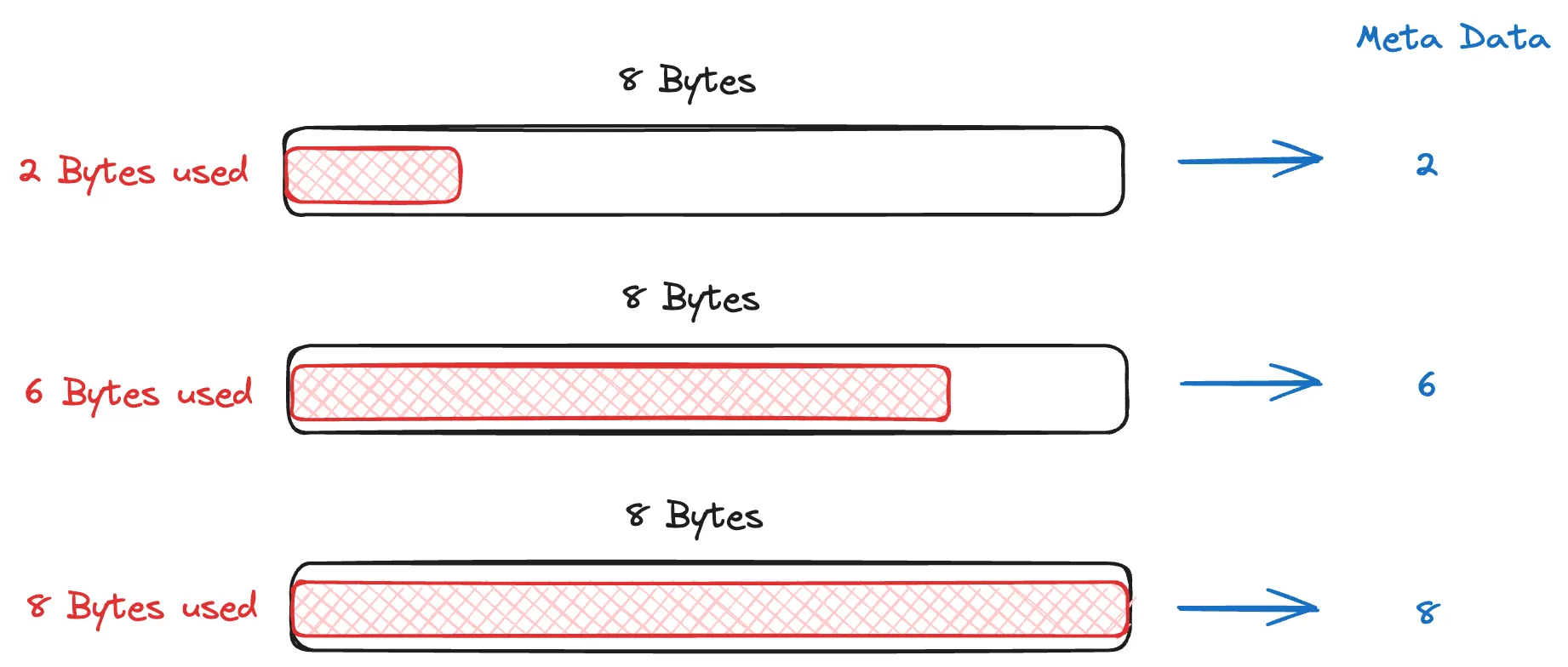
8 Bytes of memory chunk uses 1 Byte of shadow memory(metadata). The location of shadow memory in the memory is (Virtual_Address >> 3) + Offset. So we don’t have to store the mapping of memory-chunk -> shadow memory location.
Step 2. Check every memory access and check if it is valid
If calloc happens, then it writes the allocation information to shadow memory. And everytime Read/Write happens, then it references the shadow memory and validates if it violates the addressable size.
Out-of-bound error detection If program calloc 3 Bytes, and tries to write 5 Bytes:
During calloc, shadow memory value is set to 3. And before write operation, ASAN checks if the write_size is smaller or equal to shadow memory value. Since it’s not, ASAN crashes the program and notifies that out-of-bound happened in erroneous location.
Use-after-free bug detection If the program frees the memory chunk, and tries to read 5 Bytes:
If we free the memory chunk, then the shadow memory value becomes 0. Before the read operation, ASAN checks if the read_size is smaller or equal to shadow memory value. Since it’s not, ASAN crashes the program and notifies that use-after-free happened in erroneous location.
Downside of Address Sanitizer
ASAN is a powerful tool to find memory bugs. But it has a huge performance overhead because it has to check shadow memory for every memory operation(Read/Write) and memory allocation/deallocation. So we never use ASAN in production, but just in development stage.
Conclusion
ASAN makes the memory fragile(easily crashable). Many CVEs are found using ASAN+Fuzzer. Make your program robust with ASAN!