skip to content
Ball's Blog

Basics of Quantization

/ 3 min read

Updated:
Table of Contents

Summary

Current bottleneck for AI hardware is memory bandwidth. Serving large models and maintaining its KV-cache use hundreds of GB of memory. Quantization is a technique that is used during model inference. Instead of using FP16, it uses INT8 or even more smaller bits. By doing so, we can use less memory(for storing model weights) and boost the compute time(for example, CUDA Tensor Core FLOPS is x2 bigger in INT8 compared to FP16 data type).

This post introduces fundamental quantization method.

Quantization

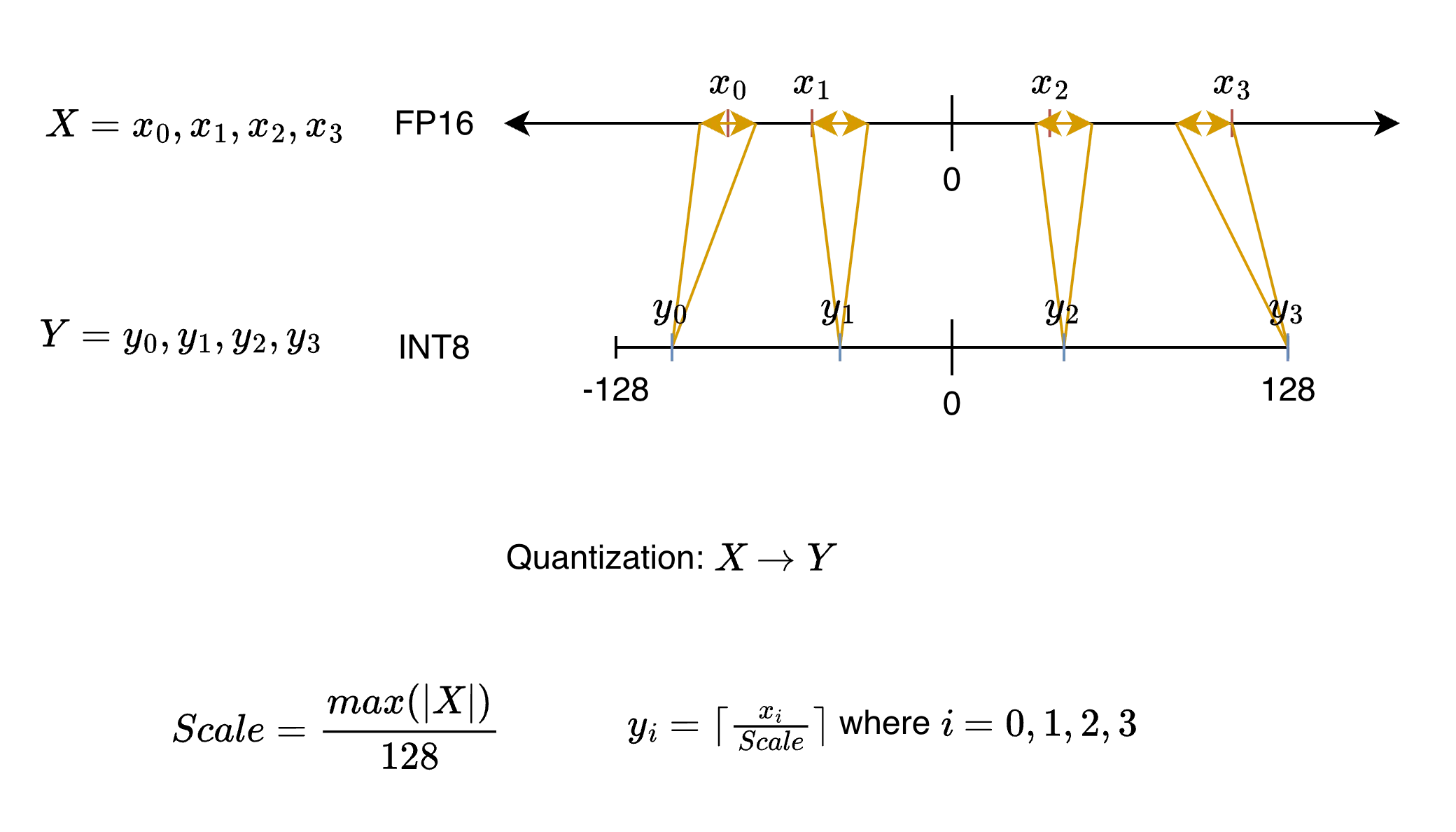
Quantization in AI is about compacting the data using lesser bits. For example, most popular quantization method nowadays is converting FP16 into INT8. By doing so, we are just using half of bits during calculation.

However, we should be careful using quantization because quantization inevitably loses precision of the data. As we quantize FP16 into INT8, and dequantize INT8 into FP16, information will be lost.

Example of Vector Quantization

Let’s say we have following data: Xfp16=[1.1,4.5,2.3,5.6]X_{fp16} = \left[ 1.1, 4.5, 2.3, 5.6 \right]

Then we can quantize it by following method:

maxXfp16max|X_{fp16}|: max element of Xfp16|X_{fp16}|

x\left\lceil x \right\rfloor: nearest integer of xx

Xint8=127×Xfp16maxXfp16=127maxXfp16×Xfp16=sXfp16×Xfp16=22.68×[1.1,4.5,2.3,5.6]=[25,102,52,127]\begin{aligned} X_{int8} &= \left\lceil \frac{127 \times X_{fp16}}{max|X_{fp16}|} \right\rfloor \\\\ &= \left\lceil \frac{127}{max|X_{fp16}|} \times X_{fp16}\right\rfloor \\\\ &= \left\lceil s_{X_{fp16}} \times X_{fp16}\right\rfloor \\\\ &= \left\lceil 22.68 \times \left[ 1.1, 4.5, 2.3, 5.6 \right] \right\rfloor \\\\ &= \left[ 25, 102, 52, 127 \right] \end{aligned} Vector Quantization

Example of Vector Multiplication with Quantization

Now let’s look at how quantization is used in multiplication. I am going to look at vector multiplication, but you can easily apply it to matrix multiplication.
Xfp16=[1.1,4.5,2.3,5.6]Yfp16=[8.7,3.5,3.3,3.6]X_{fp16} = \left[ 1.1, 4.5, 2.3, 5.6 \right] \\\\ Y_{fp16} = \left[ 8.7, -3.5, -3.3, 3.6 \right]

Let’s see how we can use quantization during cross-product: Xfp16TYfp16X_{fp16}^T \cdot Y_{fp16}

1. Quantize Xfp16X_{fp16}, Yfp16Y_{fp16} into Xint8X_{int8}, Yint8Y_{int8}

Xint8=sXfp16×Xfp16=[25,102,52,127]Yint8=sYfp16×Yfp16=[127,51,48,53]\begin{aligned} &X_{int8} = \left\lceil s_{X_{fp16}} \times X_{fp16}\right\rfloor =\left[ 25, 102, 52, 127 \right] \\\\ &Y_{int8} = \left\lceil s_{Y_{fp16}} \times Y_{fp16}\right\rfloor =\left[ 127, -51, -48, 53 \right] \\\\ \end{aligned}

2. Cross-product of Xint8X_{int8} and Yint8Y_{int8}

Cint32=Xint8TYint8=[25,102,52,127]T[127,51,48,53]=[317512751200132512954520248965406660426522496275616129647760966731]\begin{aligned} C_{int32} &= X_{int8}^T \cdot Y_{int8} \\\\ &= \left[ 25, 102, 52, 127 \right]^T \cdot \left[ 127, -51, -48, 53 \right] \\\\ &=\begin{bmatrix} 3175 & -1275 & -1200 & 1325 \\\\ 12954 & -5202 & -4896 & 5406 \\\\ 6604 & -2652 & -2496 & 2756 \\\\ 16129 & -6477 & -6096 & 6731 \\\\ \end{bmatrix} \end{aligned}

3. Dequantize Cint32C_{int32} into Cfp16C_{fp16}

Cfp16=Cint32sXfp16sYfp16=Cint32331.06=[9.593.853.624.0039.1315.7114.7916.3319.958.017.548.3248.7219.5618.4120.33]\begin{aligned} &C_{fp16} = \frac {C_{int32}}{s_{X_{fp16}} \cdot s_{Y_{fp16}}} \\\\ &= \frac {C_{int32}}{331.06} \\\\ &=\begin{bmatrix} 9.59 & -3.85 & -3.62 & 4.00 \\\\ 39.13 & -15.71 & -14.79 & 16.33 \\\\ 19.95 & -8.01 & -7.54 & 8.32 \\\\ 48.72 & -19.56 & -18.41 & 20.33 \\\\ \end{bmatrix} \end{aligned}

Benefits of Quantization

  1. Reduces activation and weight memory footprint. Since it uses INT8 instead of FP16, it halves the data size.
  2. Increases throughput. For example, NVIDIA H100 Tensor Core can perform 2x more FLOPS in INT8 compared to FP16.